Monday, 27 May 2013

PlantFibroma2final Plantar Fibroma
photo credit: Shenandoah Podiatry

Do you have plantar fibroma?

Plantar Fibroma - it presents as a hard lump or nodule under the skin in the arch of your foot. It may be a cause of pain. With information available here you may learn how to handle it easily and permanently!


What is a plantar fibroma?

A plantar fibroma is a relatively non-dangerous condition; but it can become extremely painful. A plantar fibroma is the development of what feels like a “pebble” of connective tissue. It could even feel like a much larger thickening of the cords at the bottom of your foot.
These nodules are extremely slow growing. It could take months to years before they even begin to irritate you. They eventually lead to more and more irritation. Eventually causing your toes to bend and stiffen because you adapt your biomechanics and walk improperly.

Do you have plantar fibroma symptoms?

  • usually on the inside bottom of the foot, near the highest point of the arch
  • the lump itself is usually pretty painless
  • only the pressure of the floor creates pain
  • only 1/4 people show it in both feet

Plantar fibroma risk factors:

  • family history
  • associated lumps in hands as well
  • associated with Ledderhose disease: nodules in the hand
  • associated with Peyronie’s disease:  nodules on penis shaft
  • diabetes mellitus.
fibroma Plantar Fibroma

Plantar fibroma treatment:

Treatment of the plantar fibroma depends on whether your goal is to make the pain go away, or to focus on making it disappear. The unfortunate news is that usually invasive means are the only way to make it go away permanently.

  If the nodule is small:

Treat this like plantar fasciitis to see if the symptoms get better, we have developed a 4 stage guide that will take you through the complete treatment of bottom of the foot pain. Use this only if the nodule is small!
Non-invasive options:
  • anti-inflammatory medication
  • accommodative orthoses
  • offloading padding
  • physical therapy
  • massage techniques
  • corticosteroid shots can relieve the pain

If the nodule is large:

These techniques should be reserved for the end stage of this disease. The consequences of surgery must be balanced; while the fibroma is gone, worse problems may develop.
  • corticosteroid shots can relieve the pain
  • surgical resection of the plantar fibroma - this is a very rough option, as a part of your plantar fascia would need to be removed to permanently get rid of it, so this may eventually impact your biomechanices and lead to flat foot.

For more information and advice on home and professional treatment options see this link.

Also for plantar fibroma four stage treatment guide - see this link.

Thursday, 23 May 2013

Do you have foot corn (Heloma Molle)?

Heloma Molle  or foot corn is experienced as a hard painful skin bump! Learn what it is and how to treat it!
AKA Foot Corn or Heloma Durum.
corns Heloma Molle

What is a Heloma Molle?

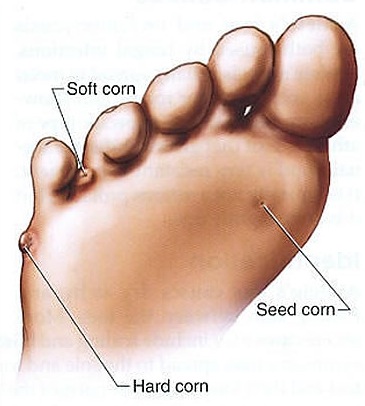
A heloma molle is a uniquely shaped callus that resembles a corn kernel. Because of it’s shape, the corn concentrates the pressure into a pinpoint area. This causes deep tissue pain and possible ulceration.

Heloma Durum vs. Heloma Molle:

A heloma durum is a hard corn, while a heloma molle is a soft corn. This is usually just semantics as both are usually treated very similarly; except the durum may need to be softened slightly more ahead of time.

Diagnosis of a Heloma Molle:

  • Thick and hard skin.
  • Deep tissue pain.
  • Shaped like a corn kernel.
  • Pinpoint pressure rather than diffuse pressure.
  • Hurts when you push on it.
  • It does not have red dots like a wart.
  • Usually in the ball of the foot, base of the big toe or 5th toe.

Foot Corn (aka Heloma) vs Callus
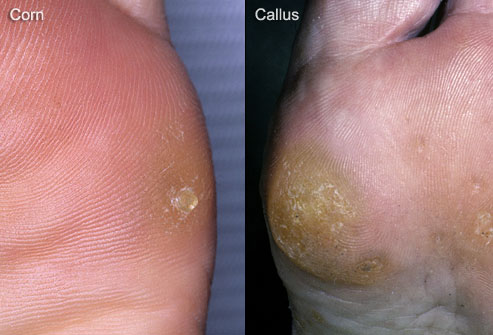
composite photo of corn and callus on foot Heloma Molle
  • Callus formation can be large and spread out. A corn is more pinpoint, small and hard.
  • Corns usually occur on the ball of the foot, under the first toe, the fifth toe and on top of the toes (especially if you have hammertoes). A callus usually occurs in the forefoot, but is usually very spread out.
  • Both can occur together- it is necessary to take the callus down then pop out the corn.

Corn vs. Wart

Plantar+Wart+picture+2 Heloma Molle
Warts have little red dot’s due blood vessels, corns and calluses do not.

  • Skin lines go through a callus, whereas if you have a wart, the skin lines go around the wart.
  • A wart can display little red “dots” that are blood vessel growth into the wart. The callus should not have any red “dots”.

What Causes A Heloma Molle?
  • Wearing loose, old or poorly stitched shoes.
  • If you ever have to really tighten your laces to get a snug fit.
  • High heels that can cause pressure or friction.
  • High arched feet form calluses under the first toe, fifth toe and under the heel.
  • Flat foot is the primary cause of increased pressure in areas of the foot, especially everywhere in the forefoot and inside part of the big toe and heel heel.
  • Rubbing in of the tops of the toes against a tight shoe is also a leading cause of corn formation in the toes.
  • The main cause: all types of biomechanical or foot deformities.

For more details and hints how to treat it at home visit this link.

Tuesday, 14 May 2013

What are you major concerns with your feet? For most people, toenail fungus is the major concern.

Out of many things that may happen to your feet the overwhelming #1 concern is the development of toenail fungus. People hate how ugly their nails look. Well, have no fear we have a complete guide for how to deal with your toenail fungus, but be warned this is an absolutely massive guide that you will need to set aside some time for!
The 2nd most common problem is an ingrown toenail. There are essential two solutions for dealing with you ingrown toenail. You can splint something under the nail at home while you continue to soften up your toenails. If softening them and then cutting the ingrown toenail does not work, then you should probably go and have a nail avulsion performed by a podiatrist or foot doctor.
Other probnlems are less common. However, a cause for concern with toenails are weird markings appearing on them. Specifically white spots and black spots on your toenails. The white spots are usually not toenail fungus, especially after you have just removed toenail polish; they are in fact keratin granulations. Black spots on the toenail may be dangerous if they are a subungual melanoma, but they are usually pretty safe because it is just dried blood under there.

Follow this link for our complete guide to find more information and home remedies to the most common problems!

Sunday, 5 May 2013

Do you have issues with keratin granulations?

Keratin granulations are the result of excessive dehydration of the keratin molecules that have turned into a chalk like substance on your nail surface; they are completely harmless and are easily corrected with a few weeks of moisturizing treatments. A common differential diagnosis of white stains on your nails is superficial white onychomycosis (which is what most doctors will tell you that you have this because it is more dangerous), – but keratin granulations are more likely, especially if they appear after removing nail polish.

What are keratin granulations?

Keratin granulations occur because the nail polish dehydrates the nail plate which is composed of molecules called keratin. These molecules clump together into a white powder that looks like chalk or a white stain on the nail.

Why is this a difficult diagnosis?

The confusing part of keratin granulations is that any podiatrist or dermatologist you go to will likely assume that your keratin granulations are really superficial white onychomycosis and start you up on medications to treat the fungus. I never even heard of keratin granulations until I heard of a situation where treatment for superficial white onychomycosis just was not working for a long time.
The reason for so little understanding of keratin granulations is because superficial white onychomycosis is more common and more dangerous, leaving it untreated can lead to eventual consequences, but leaving keratin granulations usually has no downside.
No one ever thinks to diagnose or treat keratin granulations - because it is mostly just a cosmetic problem that no one is ever worried about long term from a medical standpoint.

Who is more likely to get it?

It is more likely to occur in older people that visit nail salons and that use nail polish heavily, but it is still possible in young patients.

Is keratin granulations treatment dangerous?

Keratin Granulations Treatment is very cheap and easy to perform right at home. Within a week or two your nails should start looking cured!
No, just moisturize your nails and you should be fine; Even if you don’t moisturize your nails you should still be fine after a while without applying any more nail polish.The condition should clear up in a couple days to a couple weeks.

Keratin Granulations 300x225 Keratin Granulations Treatment

Keratin granulations treatment at home

Primary Treatment
1. Moisturizing Agent – If you have a moisturizing agent at home like Vaseline, any lotion or even oil apply this to your nail at night before you go to bed. It has been recommended that you try 10-15 minute soaks in olive oil as well by a couple magazines and I’ve heard this works.
2. Cuticle cream - This is very similar to the moisturizing agent - Burt’s Bees Wax works very well and you can apply it in the morning and throughout the day, there are other brands so just use what you are more comfortable with, they all work!
3. Easy on the nail polish- Be careful with how much nail polish you are use. Nail Polish contains dehydrating agents that cause your nail to dry while you are wearing them, this doesn’t mean you have to stop wearing polish permanently, just until your nail clears up.

Secondary Treatment
1. Wear gloves - If you are working with strong chemicals like bleach, vinegar or any other harmful agent - wear some gloves! This will give your nails a chance to heal while avoiding damage.
2. Be conscious of nail damaging activities - If you work with your hands - is it possible to protect them with gloves, or maybe just apply cuticle cream to keep them from being damaged as much.
3. Multivitamin - There are a large amount of people suggesting nail damage may be due to a lack of vitamins (especially biotin), research is limited and inconclusive in this regard, but it is entirely possible that this may be happening to you, so if you feel better - take some multivitamins!
4. Drink water and stay healthy with exercise - It is proven that with better hydration, sunlight and exercise your nails grow faster!
Note
**If it is not getting better suspect that you may have superficial white onychomycosis - but don’t worry - this is the most easily treatable nail fungus and you shouldn’t have any problems getting rid of it.  Visit our Toenail Onychomycosis page for more.

For mor information on this topic check this link.

Despite keratin granulations are a cosmetic problem, correcting it will help you to feel healthy and beautiful.  


ToeOsteochondroma 244x300 Osteochondroma in the Toe or Foot
Toe osteochondroma.

Do you have osteochondroma deformity in the toe or foot?

An osteochondroma is a noncancerous tumor that develops on the surface of a bone near a growth plate. The reason it develops near a growth plate is because cartilage is developing there and an osteochondroma is made of both bone and cartilage. The osteochondroma usually appears in childhood and adolescence and starts growing as the growth plate grows but then stops growing when the growth plate stops growing. The toe and foot osteochondroma deformity is usually something that should be monitored by not really worried about in most cases.

Cause of the toe osteochondroma deformity

Osteochondromas in the foot and toe are thought to be the most common benign (non-cancerous) bone tumors by a mile, making up about 1/3rd of all benign bone tumors in the foot. Like most tumors it is not exactly known why these things happen, anything could have caused it and it could even be genetic or through a random environmental agent.
- If you start to get multiple osteochondromas in multiple regions in the body you may need to start worrying about Maffuci’s Syndrome or other multiple osteochromatosis disorders, but otherwise you should be safe.
- It is difficult to prevent these because it is very difficult to predict who will get it and why they will get it.

Symptoms of toe and foot osteochondromas

In most people they will cause no problems and will not be noticed unless you are getting an X-ray for a different reason and the podiatrist happens to notice them.
- Painless bump that may be confused with a cyst
- Lifting of the toenail is the osteochondroma exostosis is underneath the nail
- Pain on pressure because the skin and nerves are being compressed
- Numbness or tingling because of nerve compression
- Impinged blood vessel if it is very severe

Home treatment

- The best option is to go see a podiatrist where he will give you surgical options or decide to just monitory it, but most of the time you will be ok just monitoring it
- The podiatrist will use X-ray, MRI or ultrasound to come to this decision as well as the normal physical and historical exam.

Surgery of foot and toe osteochondroma and recovery time

- Surgical is usually advocated if the podiatrist believes that the osteochondroma is:
  • causing pain
  • putting a nerve or blood vessel at risk
  • It has unusual characteristics on imaging
- If removed the osteochondroma will be checked with biopsy to see if there is anything to worry about, but usually there is not.
- The toe and foot osteochondroma surgery recovery time depends on how big it is and where the location is, but usually you should be on your feet in a couple of days or even immediately in a surgical with the main worry being to just get the wound closed.

Check this link for more information about osteochondroma.

So runners, check your feet for osteochondroma symptoms and correct this problem if needed.

Saturday, 4 May 2013

Do you experience irritant dermatitis or allergic contact dermatitis?

There are two types of dermatitis caused by substances coming in contact with the skin: primary irritant dermatitis and allergic contact dermatitis. The primary irritant dermatitis is due to a non-allergic reaction of the skin resulting from exposure to an irritating substance. Allergic contact dermatitis is the allergic sensitization to various substances.

Primary irritant dermatitis


People who work in areas where their feet are exposed to repeated or prolonged contact to chemicals, oils, or wet cement can develop primary irritant dermatitis. There are certain solutions that people soak their feet in as home remedies. Some of these solutions are safe if used properly, but their improper use can cause a significant contact dermatitis. This can result in skin break down and infection. This is particularly dangerous in people with diabetes; the result can be devastating and limb threatening. A common misconception is the value of soaking in hot water. Some people believe that the hotter the water the better. Quite to the contrary, hot water can cause damage to the skin and result in first or second-degree burns. People will soak their feet in all sorts of solutions. Common solutions are bleach, vinegar, salt water and iodine-based solutions such as betadine. If used properly and under the guidance of a doctor, these solutions can be beneficial. A common mistake that is made is to create solutions that are too strong. Should this occur, irritation to the skin and the development of a rash can develop. The dermatitis that results can also become secondarily infected.

Allergic contact dermatitis


Allergic contact dermatitis is the result of exposure to substances that sensitize the skin, so that each time one becomes exposed to it again, an inflammatory reaction will occur. Some people are allergic to the substances in the dyes of socks or the materials used to make shoes. The rash that develops is in a pattern that reflects the exposure to the substance. Adhesive tapes can cause an allergic reaction with blisters or a rash developing beneath the tape. Not all blistering or rashes from tape on the feet however are an allergic reaction. Because of the heat and the accumulation of moisture beneath the tape an acute athlete’s foot infection may occur.

Treatment


Treatment should be directed at the cause of the dermatitis. Burns should not be treated with ointments because ointments are too occlusive and can trap the heat in the burned tissues resulting in further tissue damage. Cool compresses are soothing and can limit the damage caused by the burn. The dermatitis caused by the soaking of the feet in concentrated solutions act like chemical burns and cool compresses are also useful in this instance. Dermatitis caused by an allergic reaction will respond well to topical steroid compounds like hydrocortisone cream. Steroid creams should not be used unless you are certain that the condition is caused by an allergy. Cortisone creams will mask infection and allow infections to get worse while reducing the normal inflammatory reaction associated with infections. Anti-fungal creams are useful in the treatment of athlete’s foot that may be caused by occlusion under adhesive tape.

For more details on these ailments and on home treatments check this link.

Runners, many materials and substances may cause irritation or allergic effects to your feet, so be alert!

Friday, 3 May 2013

Swollen Toenail Bed A Swollen Toe Nail Bed Causing A Deformed Nail
Swollen toe nail bed.

Do you have deformed nails and swollen toe nail bed?

A swollen toe nail bed may result in deformation of nails. It may be sometimes very irritating and painful. The deformed toenail may be on a singe toe or on more than one.
What can be done about this?

What’s happening to deformed nail?

You may have chronically thick and swollen toenail bed (or if multiple nails swollen nail beds) that is forming a callus underneath it. Often the skin under the nail has become really thick and inflamed and is likely experiencing chronic trauma. This prevents the nail from growing in normally (think of it like a big callus under and around your nail) Either your nail was damaged somehow - or you have a rigid toe or something is compressing and causing pain in the nail which is constantly there (even if not overly painful). This leads to the skin under the nail swelling and the nail loosening away from the skin, the skin becomes like a callus and this allows fungus to get under there. This makes the skin under the nail stay thick and the nail doesn’t have a chance to grow back properly.
But there is a good news! Studies are now showing that if you can correct the cause of deformation than the nail should usually grow back normally!

What can be done in case of swollen toe nail bed

1. Correct the pain and chronic irritation - it can be several things - arthritis in the toe (jamming it against the shoe), a shorter leg (needing a harder push off), bad shoes (compressing the toe), previous injury that never healed (leading to a short or long toe or joint arthritis) -  anything that is causing your toe to constantly be irritated! This needs to be corrected in order to prevent toenail from being further callused under the nail.
2. The nail may have to be removed and allowed to regrow if it is separated at all from the skin underneath it (if it was firmly attached and the color was normal that means its properly attached to non-thick skin underneath it)
3. If there is fungus under the nail that needs to also be treated check this link for details.

For more details and solutions to this problem check this link!

So runners, always take care of your feet to get further and with more fun!